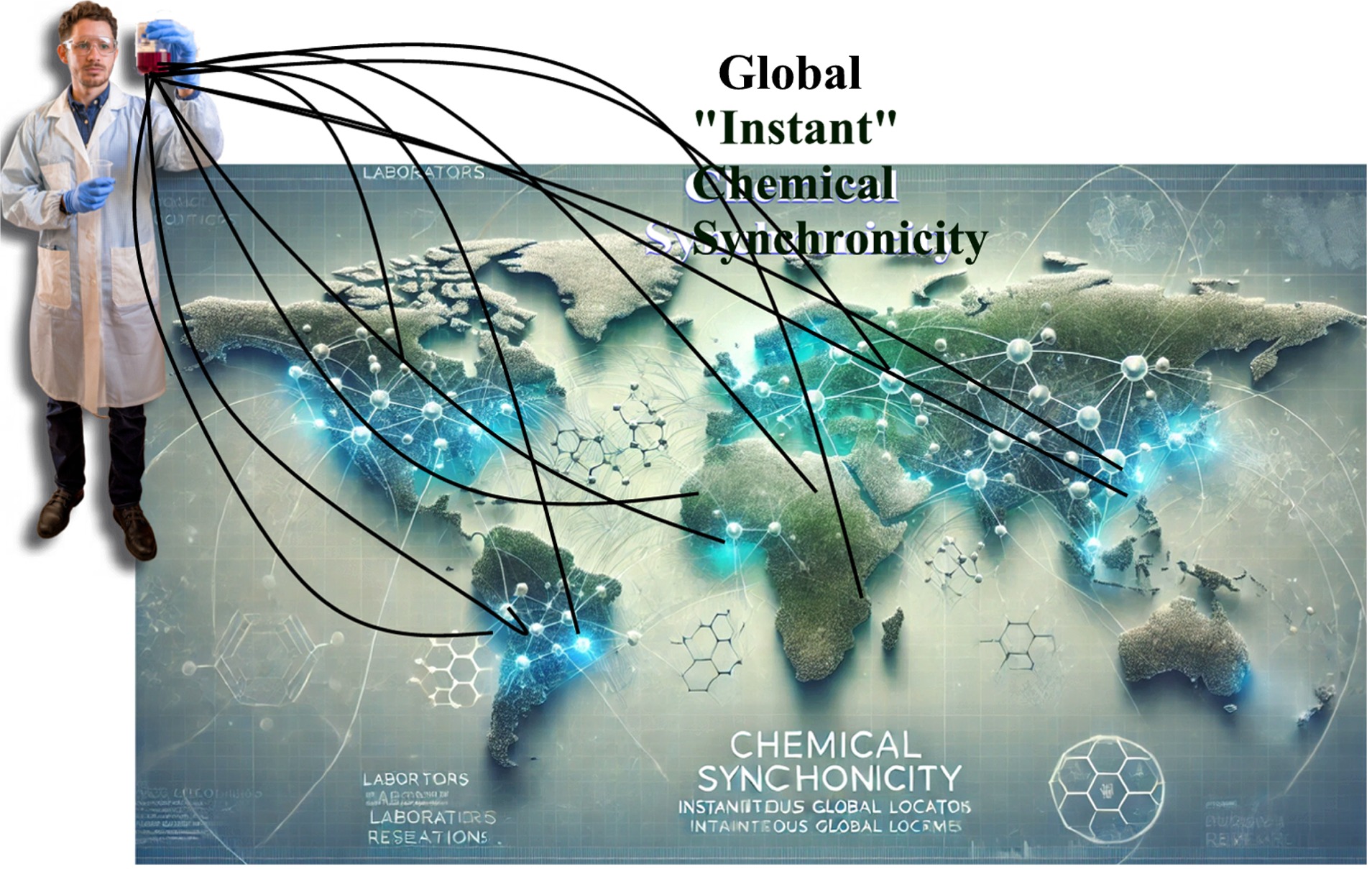
Global Chemical Synchronicity: A Challenge for Materialism and a Win for Creation
By Chris Parker 2/13/25
Introduction
1.Synchronicity: “the simultaneous occurrence of events which appear significantly related but have no discernible causal connection.” Oxford English Dictionary
In the world of chemistry, certain phenomena defy conventional explanations and challenge the boundaries of scientific understanding. Among these mysteries is the curious tendency for newly synthesized chemical compounds to consistently form the same structure worldwide after their initial synthesis.
Despite having multiple theoretical ways to bond and assemble, these compounds seem to adopt a preferred structure globally once they appear, even in conditions that should favor alternative forms. Scientists have proposed various materialist explanations—including airborne seeding and thermodynamic stability—but these theories remain incomplete.¹
Some researchers, such as biologist Rupert Sheldrake, suggest more unconventional explanations like “morphic resonance,” which posits that nature has a kind of collective memory.²
While this concept is widely debated, the implications are profound. For creationists, this phenomenon—what we will call “chemical synchronicity”—represents not only a challenge to the materialist worldview but also a potential affirmation of a universe designed with order and purpose.
The Phenomenon Explained
At the heart of this mystery lies the concept of polymorphism in crystallization, where a single chemical compound can adopt multiple structures depending on synthesis conditions.³ Once a new polymorph is synthesized, however, that particular structure seems to become the dominant form worldwide. This has been observed in pharmaceuticals, amino acids, and other molecular structures and is a common occurrence related to chemical compounds especially.
Hypothetical Case: Chemical Synchronicity in Action
Imagine a research lab synthesizing a new compound for the first time.
On paper, the compound can theoretically crystallize into several distinct polymorphic forms, each with unique physical properties. The research team carefully controls the conditions and successfully synthesizes one particular structure—a stable and previously unobserved polymorph.
Initially, this new form is seen only in their lab. However, within months, scientists in other laboratories worldwide begin synthesizing the same compound. Despite differing environments and synthesis conditions, they all obtain the exact same polymorph as the original lab—without any direct communication or shared protocols.
This sudden global consistency raises questions: What caused this uniformity? Why did all subsequent syntheses align with the first observed structure instead of following the expected probabilistic distribution?
A Historical Perspective
The observation of chemical synchronicity can be traced back to the early 20th century, when chemists began noticing that certain polymorphic forms of compounds, once discovered, quickly became dominant in laboratories across the globe. In the pharmaceutical industry, this phenomenon presented both opportunities and challenges.
For example, the spontaneous appearance of a more stable polymorph of a drug could enhance its efficacy and stability. However, it has also caused significant issues, such as when new polymorphs render existing formulations ineffective or unusable.⁴ In this respect, chemical synchronicity which is not understood can render new drugs or new formulations suddenly inert, ineffective or even dangerous.
Notable Case Studies
- **Ritonavir (an antiviral drug):** Initially manufactured in one polymorphic form, a new polymorph suddenly appeared during production and rapidly became the dominant form. This change made the drug insoluble and temporarily forced it off the market, resulting in significant financial and logistical challenges.⁵
- **Sulfanilamide:** Early researchers found that different polymorphs of this antibiotic exhibited varying degrees of effectiveness. The spontaneous emergence of a new polymorph led to a reformulation process that required extensive testing and re-approval.
Materialist Explanations
Mainstream scientists have proposed several explanations for chemical synchronicity, but none fully account for the global consistency observed.
1. Seeding Hypothesis
One popular theory is that microscopic particles from the initial synthesis act as seeds, dispersing through the atmosphere and influencing subsequent formations.
These seeds could serve as nucleation points for new crystals, ensuring that the same structure is reproduced elsewhere.⁶ The problem is, no one knows what these seeds are. Are they molecules? Are they atoms?
Are they “seeds”? and if so, has anyone described these seeds in any way other than what they are postulated to do in another materialist “Hail Mary” (pun intended) like dark matter and energy or like the infinite universes of string theory? All of the foregoing are invisible and undetectable just like the emperor’s new clothes.
Deconstructing the Seeding Hypothesis
At first glance, the seeding hypothesis seems "plausible", but a closer analysis reveals significant weaknesses.
Modern laboratories synthesize many of these compounds under strictly controlled, sealed conditions to prevent contamination. How, then, could microscopic particles from one lab spread across the globe to influence similar experiments in other sealed environments?
- Controlled Environments: Laboratories often operate in sterile, climate-controlled settings designed to minimize external interference. These conditions make it highly unlikely that airborne particles could infiltrate and act as seeds.
- Distance and Environmental Differences: Even if seeding were possible, it would need to account for the vast distances and varying environmental conditions between labs. How could a particle that originated in one location thrive and exert influence in entirely different climates and ecosystems?
- Temporal Immediacy: The rapid global adoption of a new polymorph—sometimes within weeks or months—further strains the seeding explanation. The timing is too synchronized for a process dependent on random dispersal.
Sheldrake’s Morphic Resonance
Rupert Sheldrake’s theory of morphic resonance offers a more radical perspective.
According to Sheldrake, once a particular structure is established, it creates a kind of informational field that makes it easier for similar patterns to form in the future. This “memory” of the first structure is stored in nature and accessed by subsequent molecules, allowing the structure to propagate without physical contact or seeding.²
Sheldrake, a biologist and former Research Fellow of Clare College, Cambridge, holds a Ph.D. in biochemistry from the University of Cambridge. His controversial theory of morphic resonance was first introduced in his 1981 book A New Science of Life, which generated significant debate in the scientific community.
While some hailed the book as groundbreaking, others criticized it for lacking empirical evidence. Despite the controversy, Sheldrake’s work has garnered a dedicated following and has inspired discussions across multiple disciplines, from biology to consciousness studies.
Notably, Sheldrake’s ideas have been featured in debates and interviews with prominent scientists and philosophers. His work continues to provoke discussions about the boundaries of science and the nature of reality.
His theory challenges the assumption that the universe operates purely through mechanistic processes, suggesting instead that patterns and behaviors are influenced by a kind of collective memory shared by all living organisms and even non-living matter.
Quantum Effects and the Role of the Observer
Some speculative theories involve quantum coherence or long-range molecular interactions that synchronize molecular behavior across distances. This idea, often referred to as “spooky action at a distance,” hints at potential quantum-level communication between particles.
Interestingly, the role of the observer in quantum mechanics—a well-accepted concept in mainstream physics—suggests that the very act of observation can change the outcome of an experiment.⁷
Could the first successful synthesis of a new polymorph serve as a kind of observational event that “locks in” the preferred structure globally? This possibility further blurs the lines between observation, information, and material outcomes, sounding more like Sheldrake’s morphic resonance than traditional materialist science.
Conclusion
Chemical synchronicity remains a mystery that defies easy explanation. While mainstream science continues to explore materialist hypotheses, phenomena like morphic resonance offer a bold alternative.
For creationists, these patterns in nature point to a universe imbued with meaning and order—a stark contrast to the randomness and chaos proposed by materialism.
The connections to quantum mechanics, observational influence, and spontaneous global phenomena suggest that the universe may be far more interconnected than materialist science admits.
It may be enough to defeat materialism entirely through means of proof of non-material “communication" between particles in physics or between molecules in chemistry.
There is no real materialist explanation for either of these “spooky actions at a distance” realties in the world that would permit a purely materialist explanation for the universe we live in to exist.
Whether through science, faith, or a combination of both, the search for answers continues, promising to reshape how we understand the world around us.
“For by him all things were created, in heaven and on earth, visible and invisible, whether thrones or dominions or rulers or authorities—all things were created through him and for him. And he is before all things, and in him all things hold together. Colossians 1:16-17
Footnotes
1. Bernstein, J. (2002). *Polymorphism in Molecular Crystals*. Oxford University Press.
2. Sheldrake, R. (2009). *A New Science of Life: The Hypothesis of Formative Causation*. Icon Books.
3. Mullin, J. W. (2001). *Crystallization*. Butterworth-Heinemann.
4. Bauer, J., Spanton, S., Henry, R., et al. (2001). *Ritonavir: An Extraordinary Example of Conformational Polymorphism*. *Pharmaceutical Research*, 18(6), 859–866.
5. Wheeler, J. A. (1983). *Law Without Law*. In Wheeler & Zurek (Eds.), *Quantum Theory and Measurement*. Princeton University Press.
6. Mullin, J. W. (2001). *Crystallization*. Butterworth-Heinemann.
7. Wheeler, J. A. (1983). *Law Without Law*. In Wheeler & Zurek (Eds.), *Quantum Theory and Measurement*. Princeton University Press.
Acts 2:36-38 https://www.biblegateway.com/passage/?search=acts%202%3A36-38&version=NIV
Main Website: https://www.s8int.com/
Facebook Page:
https://www.facebook.com/people/s8intcom/100063635301086/
Support s8int.com
80 + Products
s8int.com
Store: https://s8intly.myshopify.com/
**FAIR USE**
Copyright Disclaimer under section 107 of the Copyright Act 1976, allowance is made for “fair use” for purposes such as criticism, comment, news reporting, teaching, scholarship, education and research.
Fair use is a use permitted by copyright statute that might otherwise be infringing. Non-profit, educational or personal use tips the balance in favor of fair use.
Please Support the Research of S8int.com!
Support S8int.com with a PayPal Donation!
More Posts About Featured